
Quick, Draw!
Can a neural network recognize your doodle? You have 20 seconds to draw everyday objects.
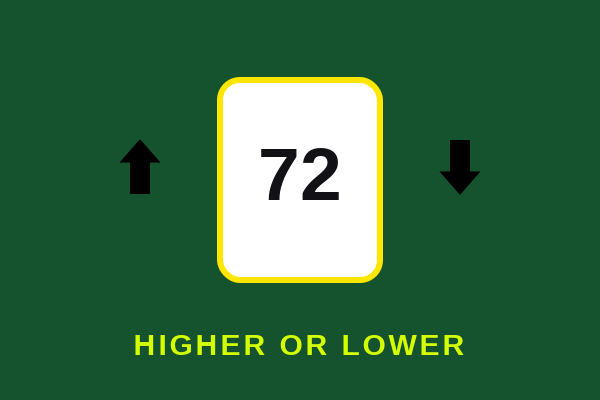
Will the next random number be higher or lower? Put your intuition and luck to the test.
This site exists purely to deliver unexpected delight and break the routine of corporate web browsing.
Higher or Lower is an electrifying game of statistical intuition, probability calculation, and gutsy risk-taking. The rules are crystal clear: a random number between 1 and 100 appears on the central card. Your only task is to predict whether the hidden upcoming number will be higher or lower than the current one. Stringing together consecutive correct guesses builds your streak multiplier, transforming simple binary choices into a thrilling high-wire act.
While predicting the outcome when the displayed number is an extreme value like 92 or 08 feels statistically straightforward, the real psychological challenge begins when the board lands on ambiguous territory around 45 to 55. Here, human intuition clashes with mathematical expected value. Players often fall victim to the gambler's fallacy, assuming that after three 'higher' cards in a row, a 'lower' card is somehow overdue, despite each draw being an independent random event.
Equipped with live streak counters, high-score tracking, and suspenseful audio cues, Higher or Lower offers quick thrills during idle moments. Will you play it safe, or push your luck when the odds are dead even? Test your mathematical sixth sense, keep your nerve steady, and see if you can achieve an unbroken streak of twenty correct predictions.
Can a neural network recognize your doodle? You have 20 seconds to draw everyday objects.
Start by manually bending paperclips, end by converting the entire universe into office supplies.
A button that pleads with you not to click it, escalating in frustration with every single press.
Description